
Is proofreading the same as Book Editing? It is one of the most common questions writers ask, and the short answer is no. Line editing, copy editing, and proofreading are three distinct stages. Each focuses on a different layer of the text, and mixing them up can waste time and money. Before diving into layout design, it is essential to understand how each stage builds the foundation for a polished manuscript.
Why the Order of Editing Matters
Think about painting a room. You fix the cracks in the wall first, then paint, then check for drips. Editing works the same way. Big problems come first and tiny ones last.
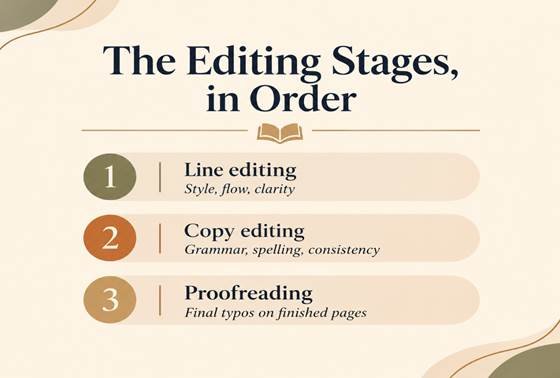
Similarly, book editing involves several stages, each serving a different purpose. The usual book editing process includes developmental editing, followed by line editing, copy editing, and finally, proofreading. This blog will cover the last three stages, since that is where most writers get confused.
The exact editing process may vary depending on the manuscript’s condition, the author’s needs, and their publishing goals. Not every book requires all four stages, but understanding what each stage offers helps authors make informed decisions.
Note: Developmental editing is an earlier stage of the editing process that focuses on the overall structure, plot, character development, content, and flow of a manuscript. Since developmental editing serves a different purpose, this article focuses on comparing the roles, differences, and purposes of line editing, copy editing, and proofreading. These three stages deal with different levels of refinement in an already developed manuscript.
What Is Line Editing?
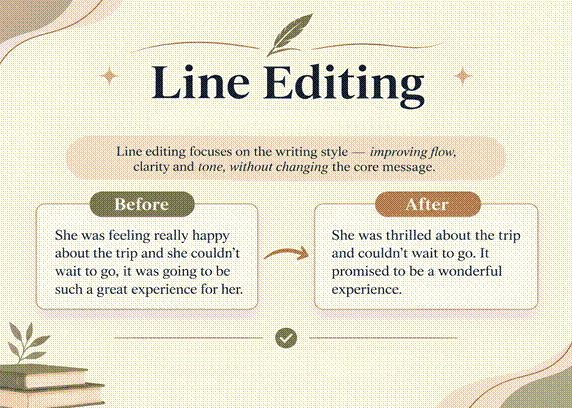
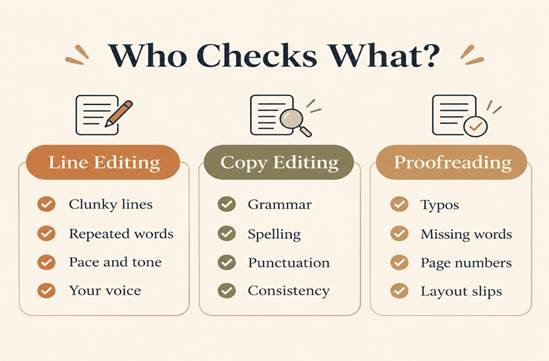
Line editing is about how writing sounds. The editor works sentence by sentence and looks at style, flow, and clarity. Wordy lines get trimmed, weak phrases get replaced, and the pace is smoothed out, all while the author’s voice stays intact.
A quick example of how line editing can improve a sentence:
- Before: “She was feeling very much afraid as she walked slowly down the long, dark hallway.”
- After: “She crept down the dark hallway, afraid.”
The idea is the same, but it is tighter and easier to picture. Line editing suits novels, memoirs, blog posts, and business writing. It is less about mistakes and more about making good writing better.
What Is Copy Editing?
Copy editing cleans up the technical side. The editor checks grammar, spelling, punctuation, and word choice. They also look for consistency, which is an essential part of the job and an area where many drafts fall short.
A copy editor will notice if a character has green eyes in chapter two and brown eyes in chapter nine. The same goes for “email” in one place and “e-mail” in another, or dates written in two different styles. Most copy editors follow a style guide, such as the Chicago Manual of Style or AP Style, to maintain consistency throughout the manuscript.
Copy editing comes after line editing. There is no point fixing commas i.n a sentence that is about to be rewritten.

What Is Proofreading?
Proofreading is the final check. It happens after your pages are laid out and look like the finished book or article. The proofreader hunts for typos, missing words, double spaces, wrong page numbers, rs and broken headings.
A proofreader generally does not rewrite sentences or make substantial changes to the manuscript. Their role is to identify and correct remaining errors, including small slips introduced during formatting, before publication.
Think of it as one last walk through the house before the guests arrive.
Proofreading also applies to digital book files. If you are publishing an ebook, the proofreader will review your formatted file to check text flow, layout consistency, image placement, navigation, and chapter links across supported devices.
Once your manuscript passes final proofreading, the next critical phase is getting your interior ready for physical production by following our complete guide on proper print format.
Which One Do You Need?
A simple way to decide is this:
- Your draft feels clunky or wordy: start with line editing.
- Your writing flows well but needs grammatical and technical corrections: go for copy editing.
- Your pages are designed and ready to publish: book a proofreader.
Authors who plan to self-publish sometimes skip an editing stage to save money, but this can lead to more expensive corrections later. A proofreader is not hired to fix clunky sentences or rewrite unclear passages, so choosing the wrong stage can mean paying for additional work. Following the right editing order helps avoid unnecessary costs.
A Few Important Guidelines
Take a break after writing, then read your draft out loud. You will hear problems your eyes miss. Ask a friend or beta reader for feedback too. Sometimes, your own eyes get tired of your own words, so a fresh pair always helps.
Before you hire an editor, ask for a short sample edit and check that you understand their process. A good editor will help you identify the right stage for your manuscript, even if it is not the one you initially requested. It is important to understand when to hire a proofreader, a line editor, or a copy editor, as each plays a different role in preparing your manuscript for publication.
Navigating the progression from raw manuscript to polished book can feel overwhelming for many authors. Knowing exactly what happens during these final layers of polishing is just as important as understanding how to fix your KDP eBook rejection issues later on.
Conclusion
Line editing makes your writing stronger, copy editing makes it accurate and consistent, and proofreading gives it a final check before publication. Each stage has its own purpose, and they work best in the right order. Understanding the difference helps you choose the editing services your manuscript actually needs and prepare it for publication with confidence.
Authors publishing a digital edition alongside their paperback need to pay close attention to file formatting. If you encounter any technical hiccups during uploading, check out our troubleshooting tips on how to fix your KDP eBook rejection before launch day.
Ready to bring your book to life? Whether you need professional editing, custom book formatting, or complete self-publishing and eBook design services, our team is here to help.
Contact us today to request a sample and discover how professional editing and formatting can prepare your manuscript for publication.
FAQs
Yes, copy editing should be completed before proofreading to ensure the manuscript is polished before its final check.
Yes, proofreading can correct remaining grammar mistakes, spelling errors, and punctuation issues before publication.
Not necessarily. The editing your book needs depends on its condition, writing quality, and publishing goals.
The cost depends on the manuscript’s word count, editing level, complexity, and the editor’s rates.
Hire a proofreader after editing and formatting are complete, just before submitting your book for publication.