
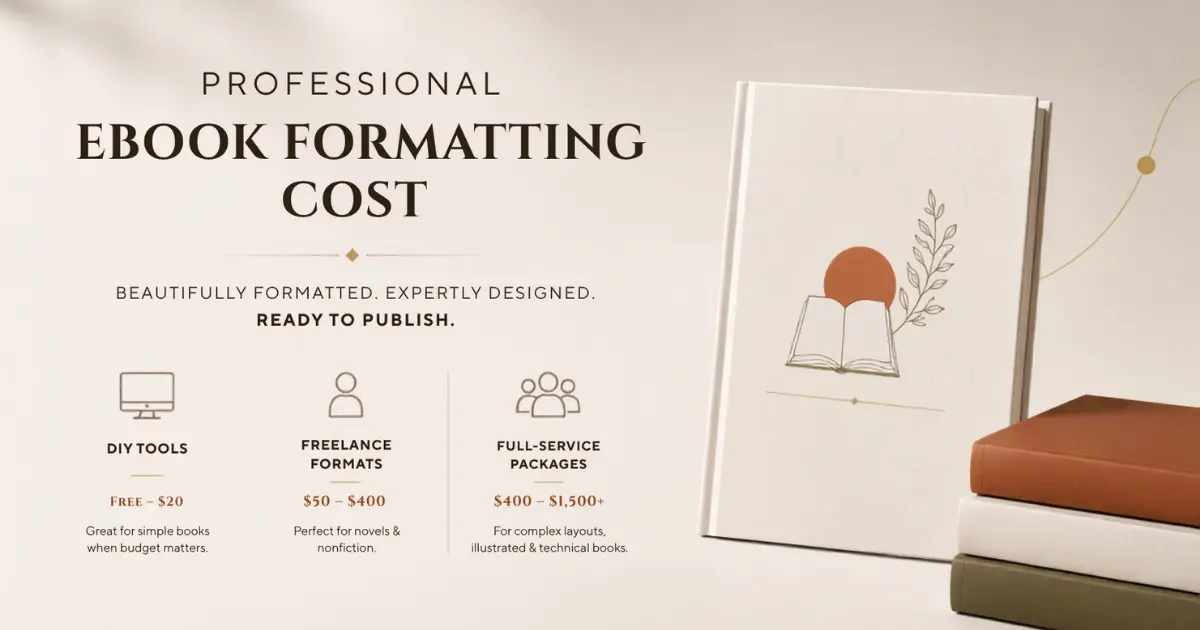
Search “how much does eBook formatting cost,” and the answer you’ll get ranges from free to over a thousand dollars. That spread isn’t a pricing scam. It reflects genuinely different services being sold under the same name. Understanding what separates them is the difference between paying $30 for exactly what your book needs and paying $30 for a template that quietly breaks on half the devices your readers use.
Here’s what actually drives the price, what each price range gets you, and how to tell if a quote is fair before you commit to it.
Why eBook Formatting Prices Vary So Widely
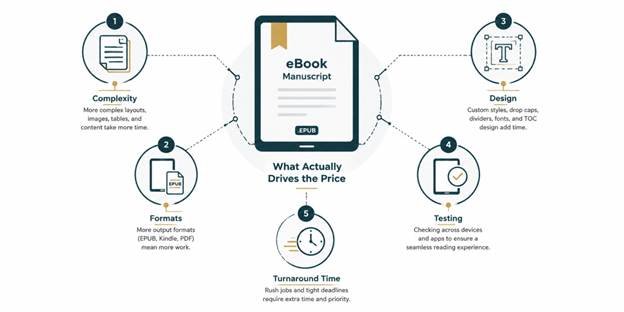
Before comparing numbers, it helps to know what’s actually being priced. A formatting quote isn’t really about word count. It’s about how much manual attention your manuscript needs to render correctly across devices. A few things consistently move the price:
- Manuscript complexity. A straightforward novel with no images formats faster than a cookbook with sidebars, a textbook with tables, or a memoir with photo inserts.
- Number of output formats. EPUB alone costs less than EPUB plus a Kindle-specific file plus a print-ready PDF, since each format has its own quirks to test.
- Design extras. Drop caps, ornamental scene-break dividers, a custom-styled table of contents, or embedded fonts all take real time to implement and test.
- Revisions and testing. A quote that includes one round of revisions and device testing across Kindle, Apple Books, and Kobo costs more.
- Turnaround time. Rush jobs cost more everywhere, not just in publishing.
Once you know which of these apply to your book, the price ranges below make a lot more sense.
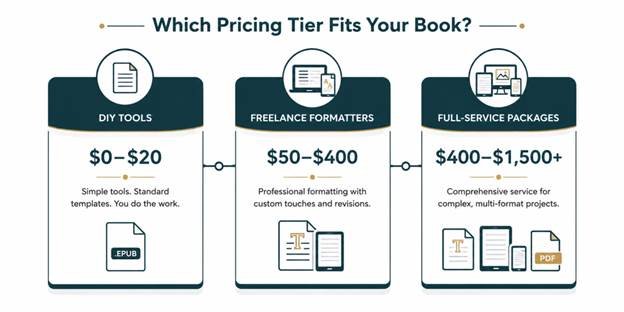
DIY Tools: Free to $20
Tools like Kindle Create, Reedsy’s free formatter, Draft2Digital, and Vellum (Mac only, one-time purchase) let you format a manuscript yourself using a guided template.
What you get: A clean, functional EPUB or Kindle file for the cost of your own time. For a straightforward, text-only novel with standard chapter breaks, these tools genuinely work well. Many self-published authors use them successfully.
What you don’t get: Custom design. Every book built on the same template looks like every other book built on that template. You also become your own quality control. If a chapter heading breaks strangely on one specific Kindle model, no one is checking that for you before it reaches readers.
This tier makes sense when your manuscript is simple, and your budget is the primary constraint. Don’t use it when the book has any visual complexity, or you don’t have time to troubleshoot formatting yourself.
Freelance Formatters: $50–$400
This is where most standalone novels and narrative nonfiction books actually get formatted. A freelancer takes your manuscript and produces a properly formatted file by hand.
What pushes a price toward the lower end ($50–$150): A single format (usually EPUB), a standard front matter (title page, copyright, simple table of contents), no illustrations, and one round of revisions.
What pushes it toward the upper end ($200–$400): Multiple output formats, custom chapter opener design (drop caps, decorative dividers), a hyperlinked and properly placed table of contents, embedded custom fonts, or a manuscript over 100,000 words.
This tier is worth it when you want a book that doesn’t look templated, but your manuscript doesn’t need the heavier production work of an illustrated or highly technical book. It’s the range most fiction and memoir authors land in.
Full-Service Packages and Agencies: $400–$1,500+
At this tier, you’re usually paying for more than formatting alone. It’s often a bundled package that includes ebook formatting, print interior layout, and sometimes basic cover work or a dedicated project manager coordinating the whole thing.
Where this tier becomes necessary rather than optional: Cookbooks, textbooks, heavily illustrated children’s books, poetry collections with unconventional line breaks, or any book where the formatting itself is part of the reading experience rather than something readers shouldn’t notice at all. These books require significant manual layout decisions that templates and most solo freelancers aren’t set up to handle at scale.
You’re also paying for faster turnaround, more revision rounds, and testing across a wider range of devices and reading apps. It matters more than it sounds like it should, since a table that renders fine on a tablet can collapse into an unreadable mess on a phone-sized Kindle screen.
This is the tier Uprisen Publishers’ interior formatting service is built for illustrated books, textbooks, and manuscripts where the layout is part of the reading experience.
What Should Be Included at Any Price Point
Regardless of which tier fits your book, a handful of things should be non-negotiable in any formatting service you pay for:
- A working, navigable TOC not just a visual list, but one that’s properly linked so a reader can jump to any chapter directly.
- Correctly structured front and back matter: title page, copyright page, and any additional front matter formatted consistently with the rest of the book.
- Testing on more than one device or app means checking the file in a Kindle-compatible viewer and an EPUB reader like Apple Books.
- At least one revision round. Formatting is rarely perfect on the first pass, and a quote with zero revisions built in is a quote where any fix costs extra.
- A validated file. Professional formatters run the finished EPUB through a validation check before delivery, catching structural errors that don’t show up visually but can cause a retailer to reject the file.
If a quote doesn’t clearly include these, ask before you pay, not after the file comes back broken.
Red Flags Worth Watching For
A few signs a formatting quote is priced lower than the actual work involved:
- No sample of previous formatted books, or samples that are only screenshots rather than files you can actually open and test yourself.
- Vague about exactly which file formats you’ll receive; “an eBook file” isn’t the same commitment as “EPUB and a Kindle-compatible file.”
- No mention of testing beyond “it works on my computer.”
- Revisions priced separately from the start, with no free round included at all.
None of these automatically mean a formatter is unqualified. But they mean you should ask specific questions before paying, like what formats, what testing, how many revisions, rather than assuming they’re covered.
FAQ’S
The software usually is, but factor in your own time. Troubleshooting a chapter break that won’t behave, or figuring out why your table of contents won’t link correctly, can easily eat several hours.
Usually because “format my novel” means different things depending on what’s inside it. A 70,000-word manuscript with fifteen simple chapter breaks is a different job than a 70,000-word manuscript with an epilogue, three POV-based formatting styles, and embedded chapter art. Even though both are technically “a novel.”
If you know you’re publishing both, bundling them with one formatter is usually cheaper than paying for two separate setups, since a lot of the underlying structural work (front matter, chapter styling decisions) overlaps between the two. If you’re only committed to one format for now, there’s no cost benefit to pre-paying for the other.
Not automatically; it guarantees more time and more included services, which usually, but not always,s translates to quality. The samples and revision policy tell you more about quality than the price tag alone does.
What This Actually Costs You
For a standard novel-length manuscript with no major design complexity, budgeting $100–$250 for professional formatting is realistic and gets you a properly tested, cleanly designed file without paying agency rates for work your book doesn’t need. Illustrated or highly structured books should expect to budget closer to $400 and up, because the work genuinely takes longer and requires more manual attention per page.
Not sure which tier your manuscript needs? Get a free formatting quote and find out before you commit to a price.
The cheapest and most expensive options can both be the right call. It depends entirely on what your manuscript needs, not on treating a lower number as automatically the better deal.
How Much Does It Cost to Edit a Book in 2026?
[…] your manuscript is fully edited, the next cost most authors underestimate is formatting. See our breakdown of eBook formatting costs in 2026 for what comes after […]